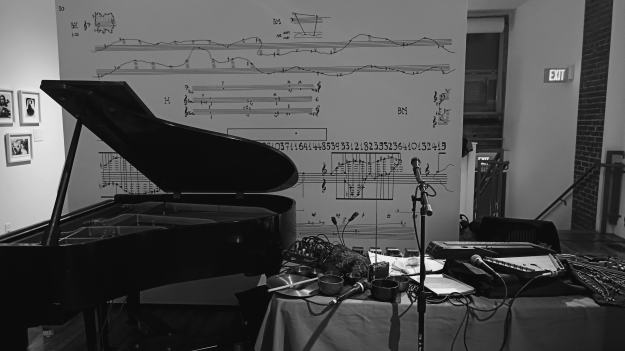
Photo: Hiroko Komiya
Thank you Mike for your wonderful review.
Review: Asheville Butoh Debut
October 30, 2025 the Butoh festival kicked off with an eagerly-anticipated performance at Black Mountain College Museum + Art Center, downtown on College Street next to Miyako Japanese restaurant across from the city’s Pack Square Park. The performing space was hung with original artworks of mid-twentieth century, interpreting the performing arts innovations at famous Black Mountain College during that period. The master of ceremonies offered a brief introduction to Butoh, which emerged as a new dance form in postwar Japan. They asked audience to indicate who had witnessed Butoh performed, and who had not. Audience response shared that about half had, and half hadn’t.
Throughout the performance Frequency in Motion, Asheville audience witnessed with rapt attention. No coughs or fidgeting marred the experience. As expected the new piece, which premiered Thursday night for a sold-out house, will be remembered as a landmark event in the cultural history of Asheville and a model event in the story of Butoh as a dance form in the United States.
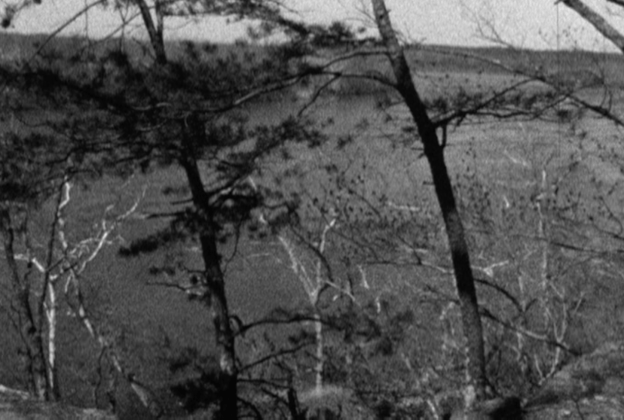
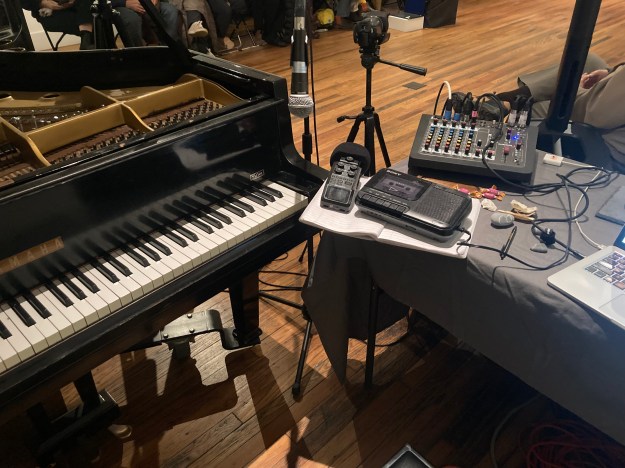
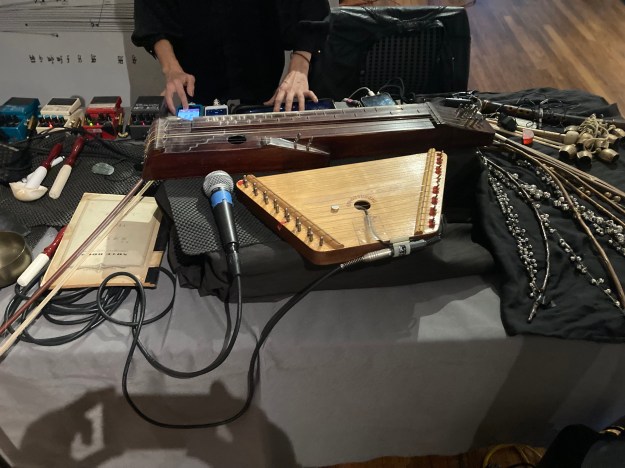
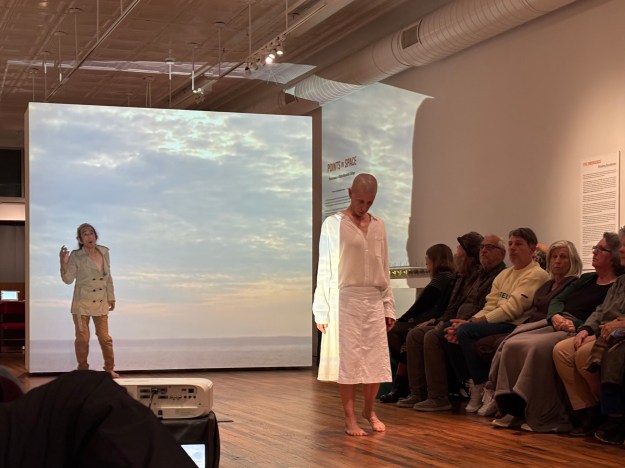
Three well-known, experienced Butoh dancers from Western North Carolina participated: Julie Becton Gillum, founder of Asheville Butoh, Jenni Cockrell and Constance Humphries. For this 15th annual Asheville Butoh Festival, Atsushi Takenouchi of Jinen Butoh joined from Japan. Also from Japan, composer Hiroko Komiya accompanied with her amazing live sound creations, partnering for sonics with Chris H. Lynn who’s based in Maryland, seated at a black grand, prepared piano. Mr Lynn also created the visuals projected on a background screen, derived from images on Super 8 and digital film.
Appropriately, audience were seated along both sides of the “stage” floor runway, the screen at one end, the musicians at the other end. Thus conceptually the Asheville audience completed “both sides” of the event, witnessing what took place from the inevitable human Opposite Point of View. Any member in audience might observe during the experience reactions on the Other Side, while watching dancers and hearing the odd sonics performed in full view. The screen, usually the focus of attention for modern audiences, became simply a backdrop offering glimpses of Nature and prosaic Modern Civilization. Lynn’s images were prosaic, neither oriental nor occidental particularly. Travelers with abundant international experience recognized them as typical scenes from ordinary life, anywhere on the planet.
The performance started at no defined moment. From behind the screen backdrop emerged each dancer individually, starting with Takenouchi. His persona is striking. He began his Butoh journey in 1980 in Hokkaido, and now is one of the world’s most memorable Butoh performers. Costumed in a tan outfit evoking love of the outdoors, his precise footwork and body movements are remarkable. In profile, his hair arrangement and the shape of his face – especially the nose – remind Americans of the noble Native American warriors of our history. Yet he is pure Japanese. Or maybe not, one of those “non Japanese” people who inhabited Hokkaido in the far north. Where the ancient people by the Bering Sea came over to become earliest Americans . . . it makes you think. Maybe ultimately it does not matter what brand of human he is. Takenouchi dances as Man.
Julie Becton Gillum emerged slowly dancing her famous persona. Clad in Butoh white costume, she presented her unique, intriguing character seen years past in many roles. Little jerks, scary facial caricatures, angst. One of the world’s most accomplished Butoh choreographers and performers, it was a treat to witness her mature performance in Frequency in Motion. Gillum moves as intriguingly as she always has in the past. Hands, feet, face and whole body arrange and resolve in ways that most dancers can never achieve in the longest lifetime of hard work and constant practice.
Jenni Cockrell came out, raven black hair, costumed as a matron in black. Her role often is in stark contrast to Gillum’s. Highly controlled, tight, deliberate with pent-up emotion she seeks to constrain. Her face reveals no emotion, except we sense she is deeply troubled, always. The head bobs a bit, the feet are timid. Her white hands beneath her black sleeves clench, her situation is pitiable.
Constance Humphries next appears to expose the fourth individual character. Head shaved, dressed all-white in classic Butoh, her movements are graceful. From poses tableau she transitions to contorted images of unusual shape. Her eyes are striking, and when she blinks we sense some hope in all this awfulness. All these characters operate alone, trudging up and down the runway by themselves unrelated to anybody else.
And then the piece develops. The characters start to interact. They touch, they bond. A key moment is when Cockrell shakes her left hand, uncontrollably. Exorcising her inner demon. Even the matron in black can join with other humanity, she transforms as one in the collective ensemble. Takenouchi’s expressive hand is silhouette on the screen projection, embracing other roles danced before us. We see where this is going.
At the denouement of Frequency in Motion the four dancers are gathered, working together. And then another surprise. Komiya leaves her musician’s space to come into the runway, bearing a small radio that’s been emitting sound into the microphone. She strides in her modern costume with it, into the dancer ensemble offering her music device into the visual mix literally and creatively. Lynn too, who’s been tossing stones about in front of a microphone and striking the piano’s strings with a soft mallet, enters the runway for the “curtain call” in front of the screen. Someone in audience begins the applause, the performance smoothly, organically concludes with audience response of appreciation. A memorable Asheville evening is now part of our collective experience.
Mike McCue



 Framing sounds
You must be logged in to post a comment.